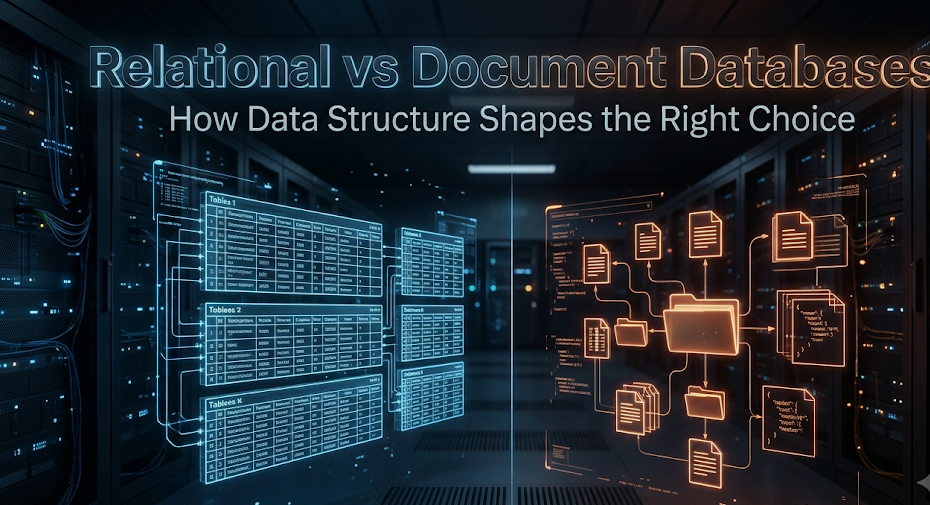
NoSQL Data Architecture & Document Modeling
One of the most dangerous misconceptions in modern software engineering is the belief that ‘NoSQL document databases have no schema, so developers don’t need data modeling’. In reality, the opposite is true: because document databases do not enforce relational constraints or multi-table ACID joins at the storage engine level, thoughtful schema design is exponentially more critical in document stores than in traditional relational databases!
In a relational database, data is modeled independently of application access patterns, relying on normalization (3NF) to support arbitrary ad-hoc SQL joins. In a document database, Data is modeled strictly to match application query and update access patterns. Modeling data incorrectly in a document store leads to massive document bloat, memory thrashing, catastrophic index degradation, and unmanageable network transfer overhead.
In this technical monograph, we dissect the core architectural design patterns, memory mechanics, and performance boundaries governing high-performance document schema engineering.
1. The Foundational Dilemma: Embedding vs. Referencing
The fundamental design choice in document modeling centers on how to represent relationships between entities: Embedding (Denormalization) or Referencing (Normalization):
1. Embedding (Denormalized Hierarchies):
Related data is nested directly as sub-documents or arrays within the parent document entity (e.g., storing a user’s residential addresses directly inside the user document). Embedding delivers unmatched read performance: retrieving the entire aggregate entity requires a single index seek and single disk page fetch with zero join processing.
2. Referencing (Normalized Pointers):
Related entities are stored as separate documents across distinct collections, linked via unique identifiers (e.g., ObjectId references). Querying referenced data requires application-level multi-query joins or aggregation pipeline operators ($lookup).
| Relationship Cardinality | Recommended Modeling Pattern | Representative Real-World Scenario | Architectural Advantage & Rationale |
|---|---|---|---|
| One-to-Few (1 to < 10) | Embed Sub-Documents | User profile and phone numbers; order billing address | Single-seek read; atomic document updates; zero join overhead |
| One-to-Many (1 to Hundreds) | Embed Array of Objects | E-commerce order and line items; blog post and tags | Fast read; must monitor document size growth against 16MB ceiling |
| One-to-Squillions (1 to 100,000+) | Reference Parent ID in Child | IoT device sensors and continuous log readings | Prevents massive array growth; child records link back to parent |
| Many-to-Many (N:M) | Bidirectional / Unidirectional References | Students and academic courses; authors and books | Prevents astronomical data duplication across collections |
2. The 16MB Document Limit and Unbounded Array Growth Hazards
In MongoDB and compatible document storage engines, individual BSON documents are capped at a strict physical limit: 16 Megabytes. This limit exists to protect server buffer pools and network bandwidth from being paralyzed by massive single-record queries.
The Anti-Pattern of Unbounded Arrays:
The most pervasive catastrophic bug in document modeling occurs when developers embed an array that can grow without upper bound (e.g., embedding all comments inside a viral blog post, or embedding all sensor readings inside an IoT machine document):
- Buffer Pool Eviction: Fetching a 15MB document into memory consumes massive RAM, evicting hundreds of smaller, frequently accessed cache pages.
- Disk Reallocation Thrashing: In WiredTiger, appending new items to an embedded array causes the document to exceed its allocated disk space, forcing the storage engine to reallocate physical pages, rewrite indexes, and fragment disk blocks.
- Document Size Failure: Once comments exceed 16MB, the database rejects all incoming writes, crashing production user workflows.
3. The Bucket Pattern: Optimizing Time-Series and High-Volume Feeds
To capture continuous streaming events (such as IoT telemetry or financial price ticks) in a document database without violating the 16MB ceiling or generating billions of individual single-measurement documents, architects deploy the Bucket Pattern:
{
  "_id": "sensor_42_2026-10-12_14:00",
  "device_id": "sensor_42",
  "bucket_start": ISODate("2026-10-12T14:00:00Z"),
  "bucket_end": ISODate("2026-10-12T14:59:59Z"),
  "count": 60,
  "measurements": [
    { "sec": 0, "temp": 24.2, "voltage": 3.28 },
    { "sec": 60, "temp": 24.3, "voltage": 3.27 }
    // Max 60 measurements per bucket
  ]
}
The Operational Benefits of Bucketing:
Instead of indexing 60 separate documents per hour, the engine indexes a single bucket document. Pre-aggregating 60 measurements per document reduces total index entries by 98%, slashes BSON metadata storage overhead, and enables fast contiguous range queries.
4. Modeling Hierarchical Trees: Ancestors, Materialized Paths, and Child References
Modeling hierarchical category taxonomies (e.g., e-commerce product categories) in document databases requires specialized tree representation patterns:
- Parent References: Each node stores a pointer to its immediate parent:
{ _id: 'laptops', parent: 'computers' }. Simple to update, but requires multiple recursive queries to resolve full breadcrumbs. - Ancestors Array Pattern: Each node stores an array of all ancestor IDs:
{ _id: 'macbook', ancestors: ['electronics', 'computers', 'laptops'] }. Creating an index onancestorsallows finding all descendants of ‘electronics’ in a single high-efficiency query! - Materialized Path Pattern: Encodes hierarchy as a breadcrumb string:
{ _id: 'macbook', path: ',electronics,computers,laptops,' }. Allows subtree queries via regex prefix scans:db.categories.find({ path: /^,electronics,computers,/ }).
5. Advanced Document Patterns: Schema Versioning and Polymorphic Pattern
As enterprise applications evolve over years of continuous deployment, document schemas inevitably change. In traditional relational databases, adding or altering columns requires blocking ALTER TABLE migrations. In document databases, developers leverage document polymorphism and Schema Versioning Patterns to manage schema evolution without a single second of cluster downtime:
The Schema Versioning Pattern:
Every document in a collection includes a dedicated integer version attribute: schema_version: 1. When application features expand (e.g., splitting a full_name string into first_name and last_name), the application code supports both versions simultaneously:
// Document Version 1:
{ "_id": 101, "schema_version": 1, "name": "Dr. Adrian Vance" }

// Document Version 2 (Evolved):
{ "_id": 102, "schema_version": 2, "first_name": "Adrian", "last_name": "Vance", "title": "Dr." }
When the application reads Version 1 documents, it executes an in-memory transformation handler on the fly. When modified documents are saved back to the database, they are persisted as Version 2. This Lazy Migration Strategy eliminates risky bulk migration scripts and allows billions of records to migrate organically over time.
The Polymorphic Pattern:
When different entities share common baseline attributes but possess widely divergent specialized fields (e.g., an insurance system managing automobile, health, and commercial property policies), all policies can reside within a single policies collection. Common fields (policy_id, insured_entity, effective_date) are indexed uniformly, while domain-specific sub-documents are dynamically evaluated based on a discriminator field (policy_type: 'AUTO'), simplifying microservice architecture.
6. The Computed and Subset Patterns: Conquering Long-Tail Data
To optimize document database performance under severe read-write skew, software architects deploy two specialized optimization patterns:
1. The Computed Pattern:
In high-concurrency systems, calculating mathematical aggregations repeatedly on every read (e.g., recalculating the total revenue and ticket count on an event page) chokes server CPU. The Computed Pattern calculates mathematical deltas at write time, updating pre-computed summary attributes directly inside the document via atomic operators like $inc and $mul, allowing read queries to fetch real-time totals in zero compute time.
2. The Subset Pattern (Overcoming Cache Bottlenecks):
In content applications (such as movie reviews or customer comments), a popular item might possess 50,000 reviews. Loading all reviews into memory degrades buffer cache hit ratios. The Subset Pattern splits data into two tiers: the top-10 most recent reviews are embedded directly inside the movie document (satisfying 99% of user browse queries instantly), while the complete historical archive of 50,000 reviews is stored in a separate collection accessed only when users explicitly click ‘View All Reviews’.
7. Document Database Indexing Strategies: Multikey and Compound Indexes
Indexing in document databases differs fundamentally from relational B-Trees due to the presence of nested objects and arrays:
| Index Type | Internal Operational Mechanism | Primary Performance Benefit & Use Case |
|---|---|---|
| Single Field Index | Standard B-Tree index on top-level scalar field | Fast equality and range queries on root attributes |
| Compound Index (ESR Rule) | Multi-field index following Equality, Sort, Range sequence | Crucial for high-performance multi-attribute filtering and sorting |
| Multikey Index (Array Indexing) | Creates index entries for every individual element inside an array | Enables high-speed tag searching; index size grows proportionally to array length |
| Wildcard Index ($**) | Indexes all arbitrary fields or sub-documents dynamically | Ideal for user-defined attributes and highly polymorphic product schemas |
| Partial / Sparse Index | Indexes only documents that satisfy a specific filter condition | Slashing index RAM footprint by 70-90% for sparse attributes |
8. Anti-Patterns to Avoid in Document Modeling
When transitioning from relational backgrounds, developers frequently fall into destructive anti-patterns:
- Anti-Pattern 1: Relational Emulation: Designing collections as strict 1:1 copies of relational 3NF tables, forcing the application to execute dozens of
$lookupaggregation stages for every single page load. - Anti-Pattern 2: The Monolithic Mega-Document: Embedding all associated corporate entities into a single gargantuan document that approaches the 16MB ceiling, thrashing WiredTiger cache and network bandwidth.
- Anti-Pattern 3: Ignoring Field Name Overhead: In BSON, field name strings are stored redundantly within every single document. Using verbose field names (e.g.,
transaction_identification_numberinstead oftx_id) across billions of documents wastes tens of gigabytes of expensive RAM and disk space.
9. The Outlier and Extended Reference Patterns in High-Throughput Document Stores
In high-throughput document database environments like MongoDB, DocumentDB, and Couchbase, generic schema patterns frequently break down when faced with extreme data distribution skew (the Pareto 80/20 principle). To resolve these performance bottlenecks, modern data engineers implement two specialized structural patterns: the Outlier Pattern and the Extended Reference Pattern.
1. The Outlier Pattern (Handling Asymmetric Celebrity Nodes):
In social networking, media streaming, and retail platforms, 99.9% of entities adhere to normal distribution boundaries (e.g., an average user has 150 followers, an average product has 12 reviews). However, a small handful of celebrity accounts or viral products accumulate tens of millions of connections. If an architect optimizes the schema exclusively for the 99.9% by embedding followers or reviews into an array, the celebrity documents breach the 16MB limit and choke server RAM.
The Outlier Pattern solves this dilemma elegantly. The document schema includes a boolean flag: has_overflow: true. For standard entities, related items are embedded directly inside the document. For celebrity entities, the embedded array is capped at a strict threshold (e.g., 1,000 items), and subsequent items are routed asynchronously to an overflow collection. Application queries inspect the has_overflow flag: if false, they execute a single-seek fetch; if true, they seamlessly union the embedded items with a query against the overflow collection. This delivers optimal sub-millisecond latency for 99.9% of users without risking database failure on edge cases.
2. The Extended Reference Pattern:
When two entities must remain separate collections due to independent lifecycles (e.g., Customers and Orders), retrieving an order frequently requires displaying a small handful of customer attributes (such as customer_name and phone_number) on the invoice summary screen. Standard relational referencing requires executing an expensive $lookup join for every single order query.
The Extended Reference Pattern copies only the critical, frequently read subset of attributes directly into the referencing document:
// Order Document with Extended Reference:
{
  "_id": "ord_98412",
  "order_date": ISODate("2026-10-12T08:00:00Z"),
  "order_total": 450.00,
  "customer": {
    "customer_id": "cust_101",
    "name": "Dr. Adrian Vance",
    "tier": "PLATINUM"
  },
  "line_items": [ ... ]
}
By embedding only the three attributes needed for standard order rendering, the application satisfies 95% of order dashboard queries in a single document read. If the user clicks into full customer management, the application performs a targeted read against the Customers collection. This drastically reduces server memory utilization and join latency.
10. Change Data Capture (CDC) and Polyglot Persistence Pipelines
Modern microservice enterprises rarely rely on a single database model. Instead, they embrace Polyglot Persistence: using document stores for application operational data, relational engines for accounting ledgers, elastic search clusters for full-text search, and graph databases for fraud detection.
The linchpin holding polyglot persistence together is Change Data Capture (CDC) via event streaming platforms (Apache Kafka, Debezium, AWS Kinesis):
- Oplog Tailing: In document databases, CDC engines continuously tail the internal replication log (e.g., MongoDB Oplog). Every insert, update, or deletion emits an event containing the updated document state.
- Dual-Write Elimination: In naive systems, developers attempt to write simultaneously to both MongoDB and Elasticsearch inside their application code. When the second write fails due to network partitions, the two databases drift out of sync. CDC eliminates dual-write bugs by establishing the primary document database as the single immutable source of truth, asynchronously synchronizing secondary analytical views.
- Event-Driven Cache Invalidation: Streaming change events to Redis clusters automatically invalidates cached JSON documents, ensuring near-instantaneous global cache coherence across distributed application regions.
11. Summary of Document Modeling Best Practices
To engineer resilient, high-performance document database systems, software architects follow these foundational engineering rules:
- Design for Query Patterns, Not Entities: Unlike relational modeling where schemas are decoupled from queries, document schemas must be sculpted around the exact access patterns and read-write frequencies of application screens.
- Embed for Read Velocity, Reference for Independent Lifecycles: Embed data that is read together and shares a unified lifecycle; reference data that grows unbounded or requires frequent cross-entity updates.
- Govern Schema Evolution Proactively: Utilize JSON Schema validation rules at the collection level alongside application schema version attributes to prevent unstructured data rot over multi-year software lifecycles.