SOFTWARE ARCHITECTURE / DATABASE DESIGN
Tables or Documents? Choosing a Database That Fits Your Data
Explore how relational and document databases organize information, manage relationships, support queries, and influence application design.
Every application needs a reliable way to store and retrieve information. An online store manages customers, products, and orders. A content platform stores articles, authors, and comments. A mobile application may track user preferences, activity, and personalized settings.
Although these applications all use databases, their information does not necessarily fit the same structure. Some data is highly organized and connected through clear relationships, while other data varies considerably from one record to another.
This distinction is central to the choice between relational databases and document databases. Both can support sophisticated applications, but they encourage different approaches to organizing and accessing information.
The best choice depends on the shape of the data, the queries an application must perform, its consistency requirements, and how the system is expected to evolve.
What Is a Relational Database?
A relational database organizes information into tables containing rows and columns. Each row represents a record, while columns define the attributes stored for that type of record.
For example, an online store might maintain separate tables for customers, products, orders, and order items. These tables can be connected using primary keys and foreign keys, allowing the database to represent relationships without repeating every detail in every record.
Relational databases commonly use Structured Query Language, or SQL, to retrieve and modify information. Well-known relational database systems include PostgreSQL, MySQL, and Microsoft SQL Server.
A major advantage of the relational model is its ability to represent structured relationships and enforce constraints. This makes it particularly useful when data accuracy and consistency are essential.
What Is a Document Database?
A document database stores information as documents rather than distributing every record across a fixed set of related tables. Documents commonly use JSON-like structures containing fields, nested objects, and arrays.
A customer document, for instance, might include a name, contact information, shipping addresses, and preferences within a single logical record. Another customer document may contain additional fields without requiring every document in the collection to share an identical structure.
MongoDB and Couchbase are examples of systems that support document-oriented data models. Their query capabilities, transaction support, and indexing features differ, so the term document database does not describe one uniform implementation.
Document databases are often attractive when application records naturally form self-contained objects or when different records require varying attributes.
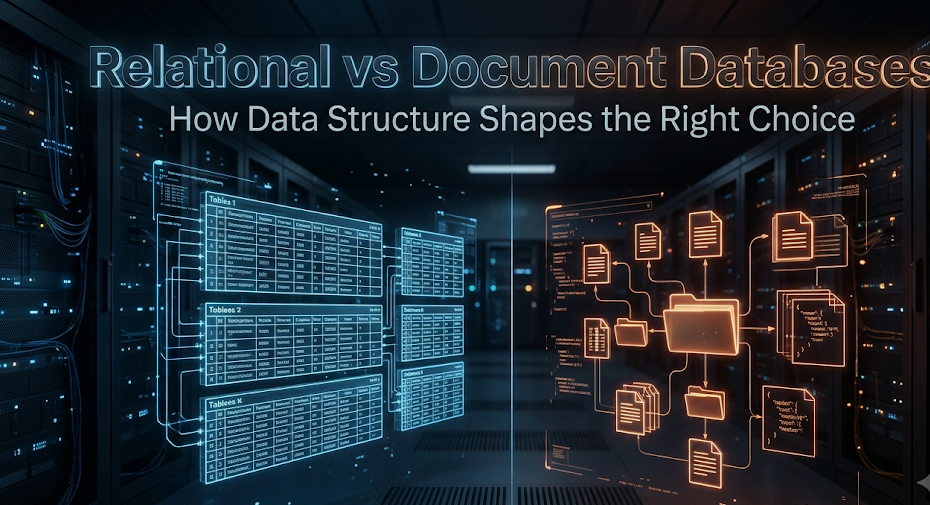
MODEL 01 / RELATIONAL
Connected Tables
Data is organized into defined tables with relationships represented through keys and constraints.
MODEL 02 / DOCUMENT
Flexible Records
Related information can be grouped into nested documents with structures tailored to individual records.
How Data Structure Changes Application Design
Consider an online bookstore that stores customer orders. In a relational design, customers and orders may occupy separate tables, with each order containing a customer identifier. Individual purchased products can be represented in an order-items table.
This arrangement avoids duplicating customer details throughout the database and supports queries across multiple entities. For example, an application can identify every order associated with a particular customer or calculate sales totals across product categories.
A document design might store an order with its purchased items embedded in the same document. This can make it convenient to retrieve the complete order with one request, especially when the application normally displays orders as self-contained records.
Neither design is automatically more efficient. The result depends on document size, indexing, query patterns, update frequency, and whether information must be shared across records.
A Simple SQL Data Example
Imagine a system that stores customers and their orders. A relational database might use two connected tables, allowing customer information to be maintained independently from order records.
EXAMPLE / RELATIONAL QUERY
SELECT customers.name, orders.total
FROM customers
JOIN orders
  ON customers.id = orders.customer_id
WHERE orders.total > 100;
This query joins customer and order records using a shared identifier. It then returns orders above a specified amount along with the associated customer names.
SQL joins are especially useful when applications need to combine information across related entities. However, query performance still depends on indexing, database design, and the amount of data being processed.
A Simple Document Database Example
A document-oriented application might represent an individual order as a single structured object. The record could contain customer information and an array of purchased items.
EXAMPLE / JSON DOCUMENT
{
  "orderId": 1042,
  "customerId": 18,
  "items": [
    {
      "product": "Notebook",
      "quantity": 2
    },
    {
      "product": "Pen",
      "quantity": 3
    }
  ],
  "total": 42.50
}
This structure keeps the order’s items together, making it convenient to retrieve the complete order. The customer identifier can still reference information stored elsewhere, while selected details may be embedded when appropriate.
The challenge is deciding what belongs inside a document and what should remain separate. Embedding too much information can create oversized records or make shared information difficult to update consistently.
Schema Flexibility: Fixed Structure vs Adaptable Documents
Relational databases generally use explicit schemas that define tables, column types, and constraints. These structures help applications maintain predictable data formats and reject invalid values.
Document databases commonly allow more variation between records. A product catalog, for example, might contain laptops with processor specifications, clothing with size information, and furniture with material descriptions.
This flexibility can simplify applications that manage diverse record types. However, flexible schemas do not eliminate the need for careful data modeling, validation, or migration planning.
Modern relational systems can also store flexible JSON data, while many document databases support schema validation. The distinction is therefore about the primary data model rather than an absolute division between rigid and flexible systems.
How Relationships Influence the Choice
Relationships are a major consideration when selecting a database. Applications such as banking systems, inventory platforms, and accounting software often manage entities with strong connections and strict consistency requirements.
Relational databases provide mature tools for representing these relationships through foreign keys, joins, and transactional constraints. They can help prevent records from referencing nonexistent entities or violating business rules.
Document databases can also represent relationships through embedded data and references. This approach works particularly well when related information is usually accessed together and updated as one logical unit.
Problems arise when the same information is duplicated across many documents and must be updated consistently. In those situations, the convenience of embedding needs to be weighed against maintenance complexity.
Transactions and Data Consistency
A transaction groups database operations so they can be completed reliably. For example, transferring money between accounts requires coordinated changes that should either succeed together or fail together.
Relational databases are widely associated with ACID transactions, which address atomicity, consistency, isolation, and durability. These properties help protect data during concurrent operations and system failures.
Many modern document databases also support ACID transactions, including operations spanning multiple documents. Consequently, it is incorrect to assume that document databases cannot handle transactional workloads.
The practical differences involve transaction scope, implementation details, performance trade-offs, and how naturally the application’s data model fits the database.
ARCHITECTURE NOTE / CONSISTENCY
Database Category Alone Does Not Determine Transaction Reliability.
Evaluate the guarantees provided by the specific database system, its configuration, and the operations your application needs.
Query Performance and Indexing
Relational databases are often effective for complex queries involving multiple tables, aggregations, and structured reporting. SQL provides a standardized language for expressing many of these operations.
Document databases can perform efficiently when queries retrieve complete documents or filter records using indexed fields. Many also support sophisticated aggregation pipelines and other advanced query features.
Neither model guarantees better performance in every situation. Query speed depends on indexing, data distribution, hardware resources, caching, and the design of the workload.
Before choosing a database for performance reasons, test representative queries using realistic data volumes and access patterns.
Scalability: Can Both Handle Growing Applications?
Both relational and document databases can support large applications. Relational systems may scale through stronger servers, read replicas, partitioning, and distributed database architectures.
Many document databases offer built-in approaches to distributing data across multiple servers, although the capabilities and operational complexity vary by product.
Horizontal scaling can help distribute workloads, but it also introduces challenges involving network communication, consistency, data placement, and failure recovery.
Choosing a document database does not automatically make an application scalable. Similarly, using a relational database does not mean an application must remain limited to one server.
Scalability decisions should be based on expected data growth, transaction patterns, availability requirements, and the team’s operational expertise.
Relational vs Document Databases: Comparison Table
| Feature | Relational Database | Document Database |
|---|---|---|
| Primary Structure | Tables and rows | Documents and collections |
| Schema | Typically explicit | Often more flexible |
| Relationships | Keys and joins | Embedding and references |
| Query Style | Commonly SQL | Product-specific query interfaces |
| Transactions | Mature ACID support | Varies; many support ACID |
| Common Strength | Structured relationships | Self-contained, variable records |
| Scaling | Multiple approaches available | Multiple approaches available |
When a Relational Database Is a Good Choice
Relational databases are particularly attractive when an application manages well-defined entities with numerous relationships. Examples include financial records, order processing, employee management, and reservation systems.
They are also useful when reporting requires complex joins and when database-level constraints help enforce business rules.
Teams familiar with SQL may benefit from its mature ecosystem of development tools, analytics platforms, and administrative utilities.
However, relational databases are not limited to traditional business software. They can also support modern web applications, APIs, and systems containing semi-structured information.
When a Document Database Is a Good Choice
Document databases can work well for applications whose records naturally resemble nested objects. Content management systems, product catalogs, user profiles, and configurable application settings are common examples.
They may also be attractive when different records require different fields or when the application frequently retrieves an entire object at once.
For example, a product catalog may contain electronics, furniture, and clothing with substantially different attributes. A document model can represent those variations without requiring identical columns for every product.
Nevertheless, document databases still require thoughtful decisions about indexing, validation, references, and document growth.
Can One Application Use Both?
Yes. Some applications use multiple database technologies because different workloads benefit from different data models.
An online platform might use a relational database for orders and payments while using a document database for flexible product information or content records.
This approach is sometimes called polyglot persistence.
However, using multiple databases introduces additional operational responsibilities, including data synchronization, monitoring, backup procedures, and consistency management.
For smaller projects, one well-designed database is often simpler to maintain than several specialized systems.
Frequently Asked Questions
What is the main difference between relational and document databases?
Relational databases organize records into connected tables, while document databases primarily store information as structured documents containing fields and nested data.
Are document databases always faster than SQL databases?
No. Performance depends on query patterns, indexes, data models, hardware, and the specific database implementation.
Can document databases support transactions?
Yes. Many modern document databases support ACID transactions, although their features and performance characteristics vary.
Which database is better for an online store?
Relational databases are often suitable for orders, payments, and inventory. Document databases can be useful for flexible product catalogs and other object-oriented records.
Do relational databases support JSON?
Many modern relational database systems support JSON storage and querying alongside traditional tables.
Are document databases schema-free?
They often allow flexible document structures, but applications still benefit from schemas, validation rules, and consistent data modeling.
Can an application use both database types?
Yes. Different database systems can support different workloads, although this increases architectural and operational complexity.
Final Thoughts
Relational and document databases provide different ways to organize and manage application information. Relational systems emphasize tables, explicit relationships, and structured constraints, while document databases emphasize flexible records that can contain nested information.
Neither approach is universally better. A relational database may be a natural fit for applications with complex relationships and strict data rules, while a document database may simplify workloads built around self-contained or variable records.
The right choice begins with understanding the application’s data rather than selecting a technology because it is popular. Consider how information is created, updated, connected, and queried before deciding how it should be stored.
A database that fits these patterns will usually be easier to develop, maintain, and scale as the application grows.